
The Work
The Numbers Came First
Before the frameworks and the scholarship, there was the data.
For over seven years, a deliberate focus on secondary engagement has driven consistent double-digit growth in material circulation, year over year. What began as a district-wide effort, co-presented at WEMTA in 2022 with fellow library lead Judy Scaro, and later invited back for a regional CESA audience, became the foundation for larger questions. Those questions led to research. The research made a Masters in Library and Information Studies feel not just worthwhile but necessary — and the application of practice to studies, and studies back to practice, has only generated more questions that are still being answered.
The 2022 presentation and the data behind it are where this body of work begins.
The Ethical Influencer: A Framework in Progress
Librarians already know the problem. Students are drowning in information, and the old models for teaching them to navigate it aren’t keeping pace. We hand them checklists. We teach them to spot fake news. And then we watch them walk out the door and fall for the next well-produced piece of misinformation anyway.
The issue isn’t effort. It’s that we’ve been teaching information literacy as a set of skills to perform rather than a way of thinking to develop.
This work started with a simple question: what if we taught students to think like ethical influencers — people who understand how information is constructed, how it moves, and what responsibility comes with engaging it? Not consumers. Not skeptics. Participants with a compass.
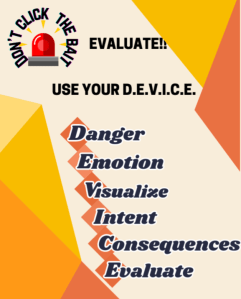
What emerged is the DEVICE framework — a living, soon-to-be classroom-tested approach to ethical information engagement that has been developed through practice, refined through failure, and is still being shaped.
WEMTA 2023 — Introduction Use Your D.E.V.I.C.E. – Introducing a Scalable Metaliteracy Framework The framework introduced. The problem named. The first attempt to put language around something librarians have been feeling for years.
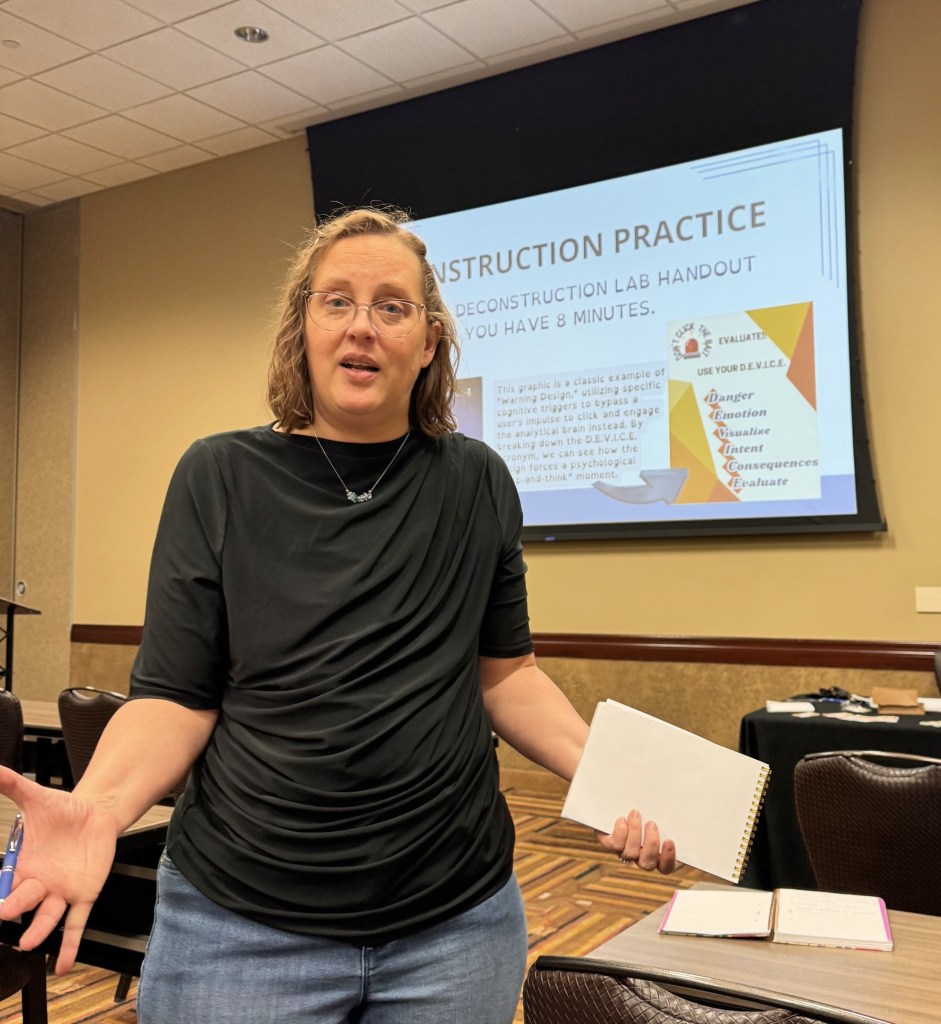
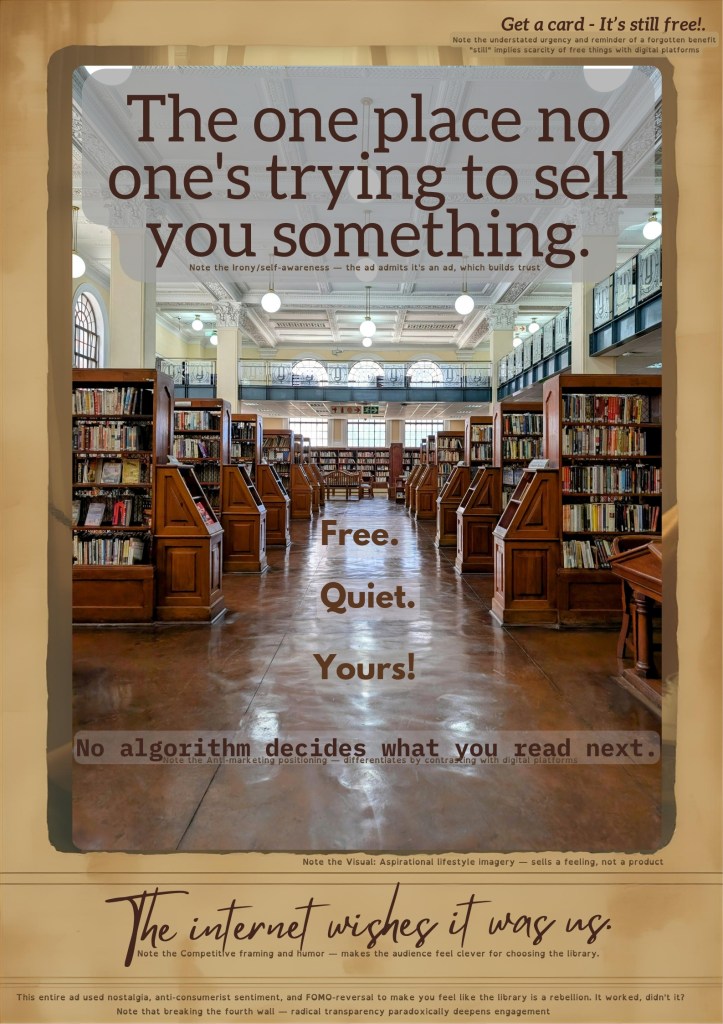
WEMTA 2026 — Application The Double-Edged Sword: Using Propaganda Techniques to Market, Educate, and Empower The framework in action. A session that asked what happens when we stop treating persuasion as the enemy and start teaching professionals – and by extension students – to wield it responsibly. Original Slide Deck1
Where it’s going
This framework is not finished — and that’s intentional. The next step is bringing it into the classroom for the first time through a collaborative lesson plan currently in development. The goal is to move from theory to practice, testing whether what has resonated with librarians and educators in a conference room holds up when students are in the seats. The work of connecting framework to instruction is ongoing, and the lesson plan is where that work is happening right now.
If that’s work you’re interested in, please reach out through the contact page!
The One-Shot, Reframed
Every librarian who has taught a single class period knows the feeling. Forty-five minutes. Twenty-five or more students. A research assignment due in a week. And the quiet hope that something — anything — lands before they walk out the door.
The one-shot isn’t going away. But the way we think about it can change.
When the one-shot is treated as a transaction — librarian delivers, students receive — it ends when the bell rings. When it’s treated as a bridge, it becomes the beginning of something. A shared language between librarian, teacher, and student. A foundation students can return to. A reason to come back to the library when the research gets hard.
That’s the shift this work is about. Not reinventing instruction from scratch, but changing the conditions around it — building the kind of collaboration that makes a single session matter more, and creating the secondary touchpoints that keep students engaged beyond the first visit.
Circulation is part of that story too. What students check out, return, renew, and abandon tells you something about how they’re engaging with information. It’s not separate from the instruction mission — it’s evidence of it.
Where this work lives right now
This is practice deepening into scholarship. The collaborative bridge model began as deep dive into one-shot library instruction research for an MLIS class, was reshaped into a professional development talk, and then restructured into a paper as part of an ALA scholarship application — a trajectory that reflects how good ideas grow when you keep working them.
The research behind it surfaces something librarians already feel but rarely see named: school and academic librarians are largely working in silos. The ACRL and AASL frameworks point toward the north star, but frameworks are maps. Maps are fascinating objects. Actually using one to get somewhere is a different skill entirely — and that gap between theory and navigation is exactly what this work is trying to close.
The data questions are still being shaped: what are teachers and faculty actually looking for, what are students reaching for, where do the gaps live between what gets taught and what gets used, and what metrics actually tell us whether any of it is working?
The formal write-up is in progress. The problem it’s solving is already in every library.
Session Materials
2022 WEMTA Increasing Student Engagement and Circulation, CESA Follow-up Presentation
2023 WEMTA Introduction of Use Your D.E.V.I.C.E Scalable Metaliteracy Framework
2026 WEMTA The Expeditions First Step: Reframing the One-Shot as a Collaborative Bridge
Ethical Influencer Quick-Start Guide and Activity Scaffold
-participant handout and activities from the session
- Materials under revision based on participant feedback – check back soon!
↩︎
 Plank and Pivot